
Digital Marketing for Small Businesses has become an important part of attracting new customers, building brand awareness, generating leads, and competing in an increasingly digital marketplace.
A small business does not always have the same marketing budget, staff, or resources as a large company. However, digital marketing can provide small businesses with multiple ways to reach potential customers online without relying entirely on traditional advertising.
Today, customers often search online before contacting a business. They may use Google to find a local service, check social media before making a purchase, read reviews, compare prices, watch videos, or visit a company’s website before making a decision.
This creates a major opportunity for small businesses.
With the right strategy, a small business can use search engines, social media, websites, email, online advertising, content, and local listings to reach people who are already interested in its products or services.
This guide explains Digital Marketing for Small Businesses in a practical and beginner-friendly way. You will learn how digital marketing can help attract more customers and how to build a simple strategy around SEO, Google Ads, social media, content marketing, email marketing, local SEO, and conversion optimization.
Table of Contents
- What Is Digital Marketing for Small Businesses?
- Why Digital Marketing Matters for Small Businesses
- Understand Your Target Customers
- Build a Professional Website
- Use Search Engine Optimization
- Focus on Local SEO
- Create Helpful Content
- Use Social Media Marketing
- Run Google Ads
- Use Meta Ads
- Build an Email Marketing Strategy
- Use WhatsApp Marketing
- Collect and Manage Customer Reviews
- Create Landing Pages
- Use Video Marketing
- Retarget Interested Visitors
- Build a Strong Brand
- Track Leads and Conversions
- Set a Realistic Digital Marketing Budget
- Avoid Common Marketing Mistakes
- Create a 90-Day Digital Marketing Plan
- Digital Marketing Checklist for Small Businesses
- Final Thoughts
What Is Digital Marketing for Small Businesses?
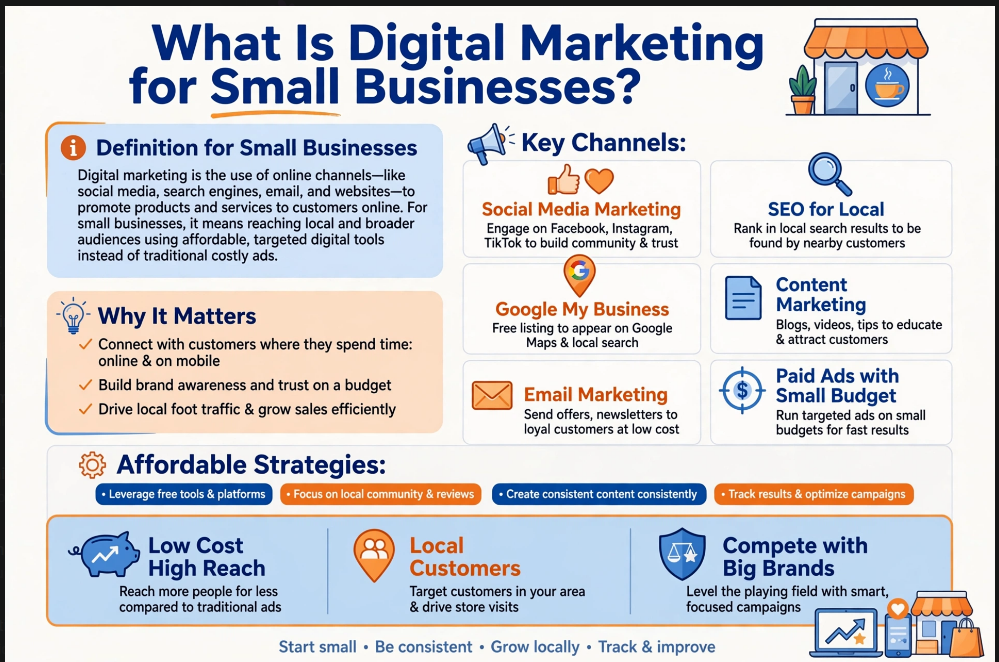
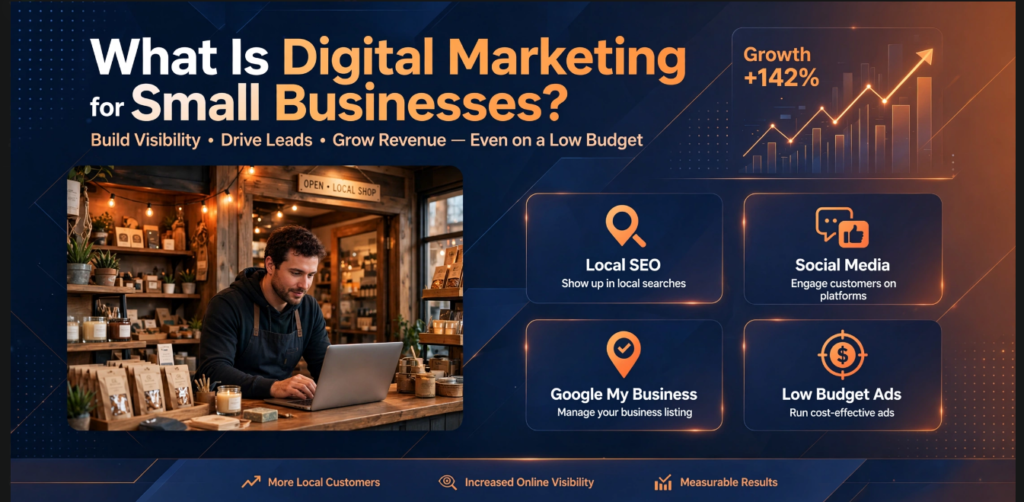
Digital Marketing for Small Businesses means using online channels and digital tools to promote a business, attract potential customers, generate leads, communicate with existing customers, and increase sales.
Unlike traditional marketing, digital marketing allows businesses to reach audiences through channels such as:
- Search engines
- Websites
- Social media
- Google Ads
- Meta Ads
- Online directories
- Video platforms
- Content marketing
Digital Marketing small business can choose only the channels that make sense for its audience.
For example, a local property consultant may focus on Google Search, Google Business Profile, local SEO, Meta Ads, WhatsApp, and property-related content.
A clothing store may focus more heavily on Instagram, Facebook, short-form video, Google Shopping, and remarketing.
A local coaching institute might focus on Google Search, YouTube, SEO, Meta lead campaigns, and WhatsApp follow-ups.
The strategy should depend on the customer rather than simply following the latest marketing trend.
Why Digital Marketing Matters for Small Businesses
One of the biggest advantages of digital marketing is accessibility.
A small business can establish an online presence without needing a massive advertising department.
Digital Marketing website can explain your services.
Google Search can help potential customers discover your business.
Social media can help you communicate with your audience.
Online advertising can help you reach specific groups of potential customers.
Email and WhatsApp can help you follow up with leads.
Analytics can help you understand which campaigns generate results.
This makes Digital Marketing for Small Businesses particularly useful when resources need to be used carefully.
However, digital marketing is not simply about being present on every platform.
The goal is to reach the right audience with the right message through the right channel.
1. Understand Your Target Customers
Before spending money on advertising, understand who you want to reach.
Many small businesses about Digital Marketing make the mistake of saying:
“Everyone is my customer.”
In reality, different products and services appeal to different groups.
Ask yourself:
- Who needs my product?
- Who needs my service?
- What problem am I solving?
- Where do potential customers search?
- What questions do they ask?
- What stops them from purchasing?
- What makes them choose one business over another?
For example, a local real estate company may target people looking to buy, rent, sell, or invest in property within specific locations.
A digital marketing agency may target business owners who need lead generation.
A local restaurant may target people searching for food in a specific area.
Understanding your audience makes every other marketing activity more focused.
2. Build a Professional Website
Your website is often the central asset of your digital marketing strategy.
Social media profiles are useful, but you should not depend entirely on platforms controlled by other companies.
Your website gives you a place where customers can learn about your business, view your services, read your content, contact you, submit forms, and take other actions.
A small business website should clearly communicate:
- What your business does
- Who you serve
- Where you operate
- What products or services you provide
- Why customers should consider you
- How customers can contact you
Your homepage should not force visitors to search for basic information.
Make important information easy to find.
Create Dedicated Service Pages
Instead of placing every service on one page, consider creating separate pages when the topics are sufficiently distinct.
For example:
/seo-services/
/google-ads-services/
/meta-ads-services/
/website-development/
This can provide a clearer experience for visitors and create additional opportunities to target relevant search queries.
You can connect these pages with internal links.
[Internal Link: SEO Services]
[Internal Link: Google Ads Services]
[Internal Link: Contact Us]
Replace these placeholders with your actual website URLs.
3. Use Search Engine Optimization
SEO is one of the most important components of Digital Marketing for Small Businesses.
Search Engine Optimization helps your website become more discoverable for relevant searches.
Imagine someone searches:
“property dealer near me”
or:
“best digital marketing agency in Delhi”
or:
“website developer for small business”
If your website provides relevant information and is technically accessible, SEO can help you compete for organic search visibility.
SEO usually involves several areas.
Keyword Research
Find the terms your potential customers actually search.
On-Page SEO
Optimize titles, headings, content, URLs, images, and internal links.
Technical SEO
Make sure search engines can crawl, process, and index your website correctly.
Content SEO
Create useful content around questions and topics relevant to your audience.
Off-Page SEO
Build legitimate authority and visibility through relevant mentions and links.
SEO is generally a long-term strategy rather than an instant traffic solution.
4. Focus on Local SEO
For businesses that serve specific geographic areas, local SEO can be particularly valuable.
Someone searching for a business often adds a location to their query.
Examples include:
- property dealer in Delhi
- salon in Meerut
- restaurant in Etawah
- digital marketing agency in Noida
- Digital Marketing near me
Create accurate local business information across your website and relevant platforms.
A Google Business Profile can help eligible businesses manage how their information appears on Google Search and Maps.
Keep your business details accurate.
Pay attention to:
- Business name
- Address
- Phone number
- Website
- Business category
- Opening hours
- Photos
- Services
- Reviews
Don’t create fake locations simply to appear in more cities.
Local SEO works best when the information genuinely represents your business.
5. Create Helpful Content
Digital Marketing can help a small business demonstrate knowledge and attract people searching for answers.
Suppose you operate a property business.
You could create articles such as:
- How to verify property documents
- Things to check before buying a house
- Property registration process
- Home buying checklist
- Questions to ask a property dealer
A digital marketing business could create:
- SEO guides
- Google Ads tutorials
- Meta Ads guides
- Website optimization tips
- Lead generation strategies
The key is relevance.
Don’t create content simply because a keyword has search volume.
Create content that can genuinely help potential customers.
Use Different Content Formats
Content doesn’t have to mean blog posts only.
You can create:
- Blog articles
- Videos
- Infographics
- Case studies
- Guides
- Checklists
- FAQs
- Social posts
- Short videos
- Email newsletters
Different customers prefer different formats.
6. Use Social Media Marketing
Digital Marketing can help small businesses communicate directly with potential and existing customers.
Platforms such as Facebook, Instagram, LinkedIn, YouTube, and other networks can serve different purposes.
Choose platforms based on your audience.
Don’t assume you need to be active on every platform.
Create Useful Social Content
Instead of posting only promotional messages, provide useful information.
For example, a real estate business can post:
- New property listings
- Market information
- Buying tips
- Property inspection tips
- Short educational videos
- Frequently asked questions
A digital marketing company can post:
- SEO tips
- Advertising tutorials
- Marketing mistakes
- Case studies
- Website tips
- Industry updates
Useful content can create reasons for people to follow your business.
7. Run Google Ads
Google Ads can provide a way to reach people actively searching for products or services.
For example, someone searching:
“property dealer in Delhi”
may already have a strong commercial intent.
A properly structured search campaign can place an advertisement in front of relevant searchers.
However, successful Google Ads requires more than simply launching a campaign.
You need to consider:
- Keyword selection
- Search intent
- Match types
- Ad copy
- Landing pages
- Location targeting
- Negative keywords
- Conversion tracking
- Budget
- Bidding strategy
Small businesses should pay particular attention to irrelevant searches.
If your campaign attracts people who are unlikely to become customers, your advertising budget can be wasted.
Review search terms regularly and add irrelevant queries to negative keyword lists when appropriate.
[Internal Link: Google Ads Guide]
8. Use Meta Ads
Facebook and Instagram advertising can help businesses reach audiences based on available targeting options and campaign objectives.
Meta Ads can be useful for:
- Lead generation
- Website traffic
- Brand awareness
- Engagement
- Retargeting
- Product promotion
For a local business, you may want to restrict targeting to the locations where you actually provide services.
The advertising message should also match the audience.
For example, a property campaign could use a specific offer or property category rather than a generic message such as:
“Buy property now!”
A stronger campaign communicates:
- What is being offered
- Where it is located
- Who it is for
- What benefit the customer receives
- What action they should take
The landing experience should match the advertisement.
9. Build an Email Marketing Strategy
Email marketing can help businesses communicate with people who have already shown interest.
You can use email to:
- Share educational content
- Send offers
- Follow up with enquiries
- Announce new products
- Share newsletters
- Nurture leads
- Retain existing customers
However, email marketing should respect applicable privacy and consent requirements.
Don’t purchase random email lists and send unsolicited marketing messages.
Build a relevant audience through legitimate signup methods.
Create Useful Email Content
A simple newsletter might include:
Subject: 5 Things to Check Before Buying a Property
Then provide useful information and a relevant CTA.
The purpose is to help the subscriber, not simply send promotional messages every day.
10. Use WhatsApp Marketing
For many small businesses, WhatsApp can become an important communication channel.
Customers may prefer WhatsApp because it is familiar and convenient.
Businesses can use it for appropriate customer communications such as:
- Enquiry follow-ups
- Appointment confirmations
- Product information
- Service updates
- Customer support
- Opt-in promotional messages
Make sure your communication follows applicable laws, platform policies, and customer consent requirements.
Avoid sending excessive unsolicited messages.
A useful WhatsApp conversation should be clear and relevant.
For example:
“Hello, you recently requested information about our property listing. Would you like the price and location details?”
is more useful than repeatedly sending generic promotional messages.
11. Collect and Manage Customer Reviews
Reviews can influence how potential customers perceive a business.
After a genuine customer interaction, you can encourage customers to share honest feedback through appropriate review platforms.
Don’t create fake reviews.
Don’t pressure customers to provide only positive feedback.
Don’t manipulate ratings.
Instead, focus on providing good service and making it easy for genuine customers to share their experiences.
Respond professionally to reviews.
If someone leaves a negative review, avoid aggressive arguments.
A calm response can communicate that your business takes customer concerns seriously.
12. Create Dedicated Landing Pages
A landing page is designed around a specific marketing objective.
For example, instead of sending a Google Ads visitor to your generic homepage, you might send them to a page specifically designed for the advertised service.
A strong landing page can include:
- Clear headline
- Short explanation
- Key benefits
- Relevant images
- Trust signals
- Testimonials where genuine
- FAQs
- Contact form
- Phone number
- Strong CTA
The landing page should match the advertisement.
If the ad says:
“SEO Services for Small Businesses”
the landing page should immediately explain those services.
Don’t make visitors search through unrelated content.
13. Use Video Marketing
Video has become an important format for digital communication.
Small businesses can create videos without expensive equipment.
You can start with a smartphone and basic lighting.
Video ideas include:
- Product demonstrations
- Service explanations
- Customer FAQs
- Tutorials
- Behind-the-scenes content
- Business introductions
- Customer testimonials
- Educational tips
For example, a property business could create a short video showing important things to inspect during a property visit.
A digital marketing company could create a video explaining three common Google Ads mistakes.
The objective should be useful communication rather than producing highly polished videos every time.
14. Retarget Interested Visitors
Not everyone who visits your website will become a customer immediately.
Someone may visit your service page, read your content, and leave.
Retargeting can help businesses reconnect with eligible audiences through advertising platforms, subject to platform rules and applicable privacy requirements.
For example, someone may visit a product page but not purchase.
A properly configured remarketing campaign may show them relevant advertising later.
However, frequency should be controlled.
Seeing the same advertisement repeatedly can become annoying.
Your remarketing strategy should therefore focus on relevance and reasonable frequency.
15. Build a Strong Brand
Digital marketing is not only about clicks.
People need to remember your business.
A consistent brand can help create recognition across your:
- Website
- Social media
- Advertisements
- Emails
- Videos
- Business profiles
- Printed materials
Use consistent:
- Business name
- Logo
- Colors
- Fonts
- Tone
- Messaging
Your branding should make it easy for customers to recognize your business.
However, branding is not just visual design.
Your actual customer experience also influences how people perceive your brand.
16. Track Leads and Conversions
Traffic is useful, but businesses ultimately need meaningful actions.
Depending on your business, a conversion could be:
- Phone call
- Form submission
- WhatsApp enquiry
- Appointment
- Purchase
- Booking
- Consultation request
- Newsletter signup
Set up conversion tracking where appropriate.
For advertising campaigns, don’t optimize only for clicks if your actual objective is generating qualified leads.
A campaign generating 1,000 clicks but no enquiries may not be achieving the business objective.
A campaign generating fewer clicks but more qualified enquiries may provide a different result.
This is why conversion tracking is essential.
17. Measure Marketing Performance
Use analytics and advertising platforms to understand what is working.
Important metrics can include:
Website Traffic
How many people visit your website?
Traffic Sources
Where do visitors come from?
- Social media
- Paid advertising
- Direct traffic
- Referrals
Leads
How many people contact you?
Conversion Rate
What percentage of visitors take the desired action?
Cost Per Lead
How much advertising spend is required to generate a lead?
Customer Acquisition Cost
How much does it cost to acquire a customer?
The exact metrics depend on your business model.
Don’t track dozens of numbers simply because they are available.
Focus on metrics connected to your business objectives.
18. Set a Realistic Digital Marketing Budget
Small businesses often have limited budgets.
That makes planning important.
Instead of spending randomly across every platform, decide:
- Monthly marketing budget
- Advertising budget
- Content budget
- Website budget
- SEO budget
- Tools/software budget
You don’t necessarily need to spend heavily from day one.
Start with a manageable budget.
Test campaigns.
Measure results.
Then adjust spending based on evidence.
For example, you might divide your monthly budget between:
- Google Ads
- Meta Ads
- SEO/content
- Website improvements
The exact allocation should depend on your business, audience, competition, margins, and conversion data.
19. Avoid Common Digital Marketing Mistakes
Several mistakes can reduce the effectiveness of Digital Marketing for Small Businesses.
Trying Every Platform
You don’t need to be everywhere.
Choose channels that your customers actually use.
Buying Fake Followers
Follower numbers don’t automatically produce customers.
Focus on relevant audiences and genuine engagement.
Keyword Stuffing
Repeatedly using keywords can make content unnatural.
Write for people first.
Ignoring Mobile Users
A website that looks good on desktop but works poorly on phones can lose potential customers.
Sending Spam
Unsolicited promotional messages can damage customer trust and may violate applicable rules.
Ignoring Analytics
Without measurement, it becomes difficult to know what is working.
Using One Generic Landing Page
Different campaigns often need different messages.
Stopping Too Early
Some marketing strategies require time and repeated testing.
20. Create a 90-Day Digital Marketing Plan
A simple 90-day plan can help a small business avoid random marketing activities.
Days 1–30: Build the Foundation
Start with:
- Website audit
- Google Business Profile
- Social media profiles
- Keyword research
- Analytics setup
- Search Console
- Conversion tracking
- Basic SEO
- Customer research
Make sure the fundamentals are working.
Days 31–60: Create and Promote
Start publishing:
- Blog content
- Social media content
- Videos
- Email newsletters
- Local content
Test appropriate paid campaigns.
Track leads and engagement.
Days 61–90: Optimize
Review the data.
Identify:
- Best-performing keywords
- Best-performing pages
- Best advertising campaigns
- Best audiences
- Most successful content
- Conversion problems
Then improve your strategy.
Don’t simply increase spending.
First understand what the data is telling you.
21. Build a Content Calendar
A content calendar can help small businesses maintain consistency.
For example:
| Day | Content |
|---|---|
| Monday | Educational social post |
| Tuesday | Short video |
| Wednesday | Blog article |
| Thursday | Customer FAQ |
| Friday | Product/service post |
| Saturday | Behind-the-scenes content |
| Sunday | Weekly recap |
You don’t have to publish every day.
The schedule should be realistic for your team.
One useful article every week can be more sustainable than publishing seven low-quality articles and stopping after one month.
22. Combine Organic and Paid Marketing
Organic and paid marketing can complement each other.
SEO may help attract organic traffic over time.
Paid advertising can help generate immediate visibility for selected campaigns.
Social media can help build awareness.
Email and WhatsApp can support customer communication.
Content can educate potential customers.
The strongest strategy is often not choosing one channel exclusively but creating a system in which different channels support each other.
For example:
Google Search → Website → Lead Form → WhatsApp Follow-Up → Customer
Another example:
Social Media → Blog → Email Signup → Educational Emails → Consultation
The exact journey will depend on your business.
23. Use Customer Data Responsibly
Digital marketing provides access to valuable customer information.
Businesses must handle this information responsibly.
Be transparent about how customer information is collected and used.
Follow applicable privacy laws, regulations, and platform requirements.
Protect customer information.
Avoid collecting unnecessary data.
Make sure forms, email systems, analytics tools, advertising platforms, and customer databases are configured responsibly.
Trust can take years to build and only moments to damage.
24. Use External SEO and Marketing Resources
Small businesses can learn a great deal from official documentation and trusted resources.
Useful resources include:
Google Search Central for SEO and Google Search documentation.
Google Search Console for search performance and indexing information.
Google Analytics for website and audience measurement.
Google Trends for exploring search interest.
Google Ads Help for advertising guidance.
Meta Business Help Center for information about Meta advertising and business tools.
When reading third-party advice, compare important recommendations with official platform documentation.
Platforms change frequently, so older tutorials may no longer reflect current features or policies.
25. Create a Customer-Focused Marketing Funnel
A marketing funnel represents the different stages a potential customer may move through.
Awareness
The person discovers your business.
Channels can include:
- Social media
- Google Search
- YouTube
- Display advertising
- Content
Consideration
The person researches your business.
They may:
- Visit your website
- Read reviews
- Compare services
- Read blog articles
- Watch videos
Conversion
The person takes action.
They may:
- Call
- Submit a form
- Send a WhatsApp message
- Purchase
- Book an appointment
Retention
After becoming a customer, they may return or recommend your business.
Email, customer support, useful content, and follow-up can contribute to retention.
Understanding this journey helps you create appropriate messages for different stages.
Digital Marketing Checklist for Small Businesses
Use this checklist to review your current marketing strategy.
Website
- Professional website
- Mobile-friendly design
- Fast-loading pages
- Clear services
- Contact information
- Strong calls to action
- Secure HTTPS
- Analytics installed
SEO
- Keyword research completed
- SEO titles optimized
- Meta descriptions written
- Short URLs
- H1/H2 structure
- Internal links
- Image ALT text
- XML sitemap
- Search Console configured
Local SEO
- Google Business Profile
- Accurate business information
- Relevant local content
- Genuine customer reviews
- Consistent contact information
Social Media
- Relevant platforms selected
- Consistent branding
- Educational content
- Video content
- Customer interaction
- Regular posting schedule
Paid Advertising
- Campaign objective defined
- Relevant audience
- Geographic targeting where appropriate
- Negative keywords for Search campaigns
- Relevant landing page
- Conversion tracking
- Regular optimization
Lead Management
- Leads tracked
- Follow-up process
- CRM or lead sheet
- WhatsApp/email follow-up
- Conversion tracking
- Customer retention strategy
Frequently Asked Questions
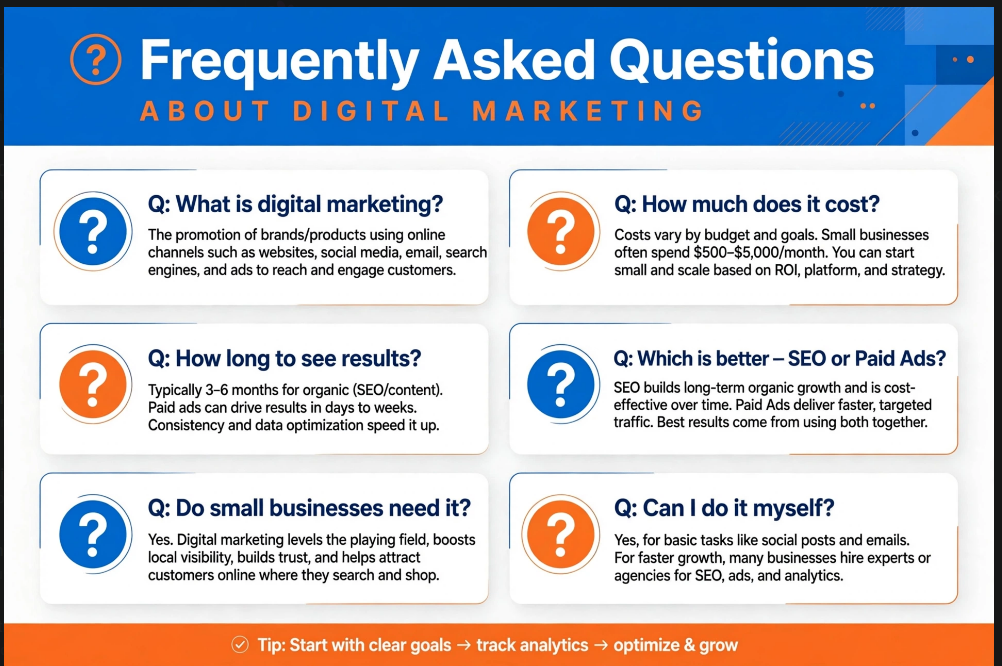
What is the best digital marketing strategy for a small business?
There is no single strategy that works equally well for every business.
The right approach depends on the target audience, location, products, services, competition, budget, and customer journey.
A local service business may benefit from local SEO and Google Search, while a visually driven business may rely more heavily on social media and video.
How much should a small business spend on digital marketing?
There is no universal amount.
Start with a budget that your business can sustain and measure the results carefully.
Separate experimental spending from essential marketing activities and increase investment based on reliable performance data.
Can a small business do SEO itself?
Yes.
Many SEO fundamentals can be learned and implemented internally.
Small businesses can start with keyword research, useful content, on-page optimization, internal linking, technical checks, local SEO, and Google Search Console.
More advanced technical work may require professional support.
How long does SEO take?
SEO timelines vary.
Competition, website history, content quality, technical condition, authority, search demand, and industry can all influence results.
SEO should generally be treated as a long-term process rather than an overnight solution.
Is social media necessary for every business?
Not necessarily.
A business should choose platforms based on where its potential customers spend time and what type of content supports the buying journey.
Being active on fewer relevant platforms can be more practical than maintaining many inactive profiles.
Should small businesses use Google Ads?
Google Ads can be useful when people actively search for the products or services a business offers.
However, campaigns need proper targeting, relevant keywords, effective ads, suitable landing pages, and conversion tracking.
Should a small business use Meta Ads?
Meta Ads can be useful for businesses that can identify relevant audiences and create suitable advertising content.
Campaign performance depends on factors such as audience, offer, creative, campaign objective, landing experience, and conversion tracking.
Final Thoughts
Digital Marketing for Small Businesses can create multiple opportunities to attract customers, build awareness, generate leads, and grow a business online.
The key is not to use every available marketing channel at once.
Start with your customers.
Understand what they need.
Find where they search.
Create useful information.
Build a professional website.
Optimize your online presence.
Use SEO to build long-term visibility.
Use paid advertising when it makes business sense.
Use social media to communicate and educate.
Use email and WhatsApp appropriately for customer communication.
Track leads and conversions.
Then improve your strategy based on real data.
Small businesses may have fewer resources than large companies, but a focused digital strategy can help those resources work more efficiently.
The most important step is to start with a clear plan, measure the results, and continuously improve.
Digital marketing is not a one-time task.
It is an ongoing process of understanding customers, creating value, testing ideas, measuring performance, and improving the customer journey.