
Introduction
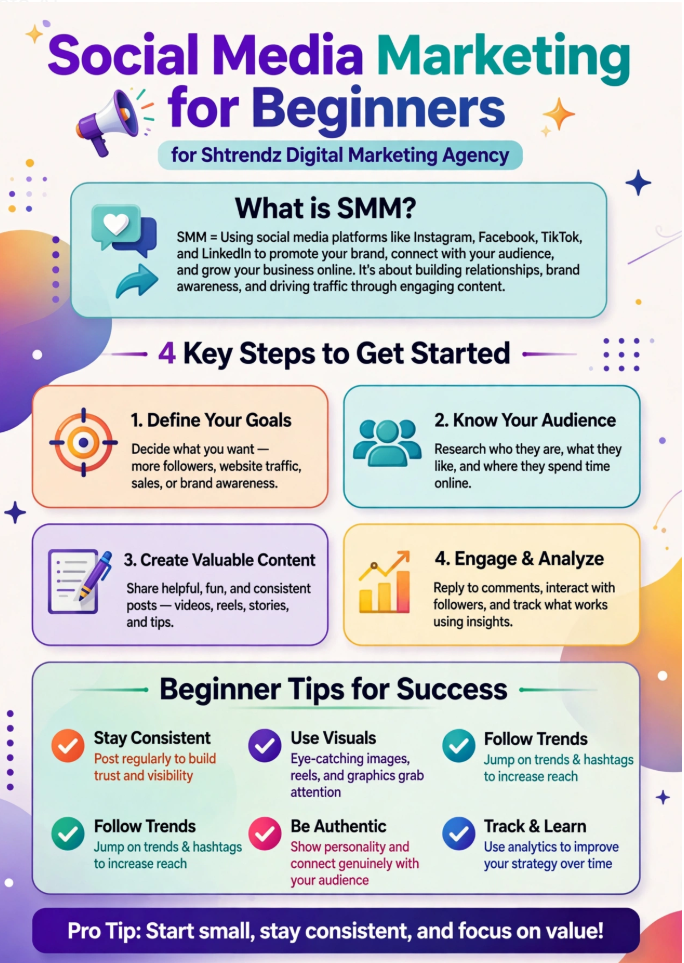
In today’s digital world, social media marketing for biginner has become one of the most powerful tools for businesses, entrepreneurs, creators, and professionals. Millions of people use social media platforms every day to communicate, discover products, share experiences, and connect with brands. For businesses, this creates an opportunity to reach potential customers, build relationships, and increase sales without relying entirely on traditional advertising.
Social media marketing for beginners is an excellent starting point for anyone who wants to understand how businesses use social platforms to grow their online presence. Whether you own a small business, run an online store, provide services, or want to build your personal brand, social media marketing can help you reach your goals.
However, simply creating an account and posting pictures is not enough. Successful social media marketing requires a clear strategy, engaging content, consistent communication, and regular performance analysis.
In this complete guide, you will learn what social media marketing is, why it matters, which platforms you should use, how to create engaging content, and how to develop a strategy that supports long-term business growth.
What Is Social Media Marketing?
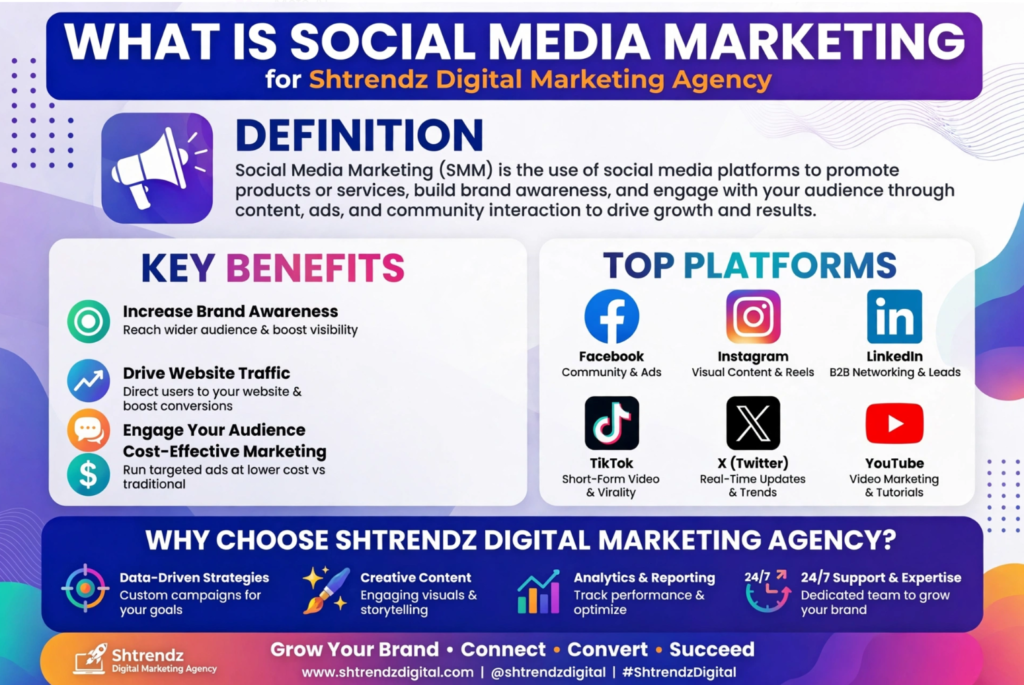
Social media marketing is the process of using social media platforms to promote a business, product, service, or personal brand. It involves creating and sharing content, engaging with followers, building communities, running advertising campaigns, and analyzing results.
Businesses use social media marketing to communicate directly with their target audience and establish a recognizable online identity.
Popular social media platforms include:
- YouTube
- TikTok, where available
- X, formerly Twitter
Each platform has different features and attracts different audiences. Therefore, businesses should select platforms according to their objectives, audience preferences, and content capabilities.
For example, a clothing business might use Instagram to showcase new collections, Facebook to build a customer community, and WhatsApp Business to answer inquiries. A digital marketing agency might use LinkedIn to connect with professionals and Instagram to demonstrate its creative work.
The main purpose of social media marketing is not simply to collect followers. It is to attract the right audience, build trust, and encourage meaningful actions such as website visits, inquiries, registrations, and purchases.
Why Is Social Media Marketing Important?
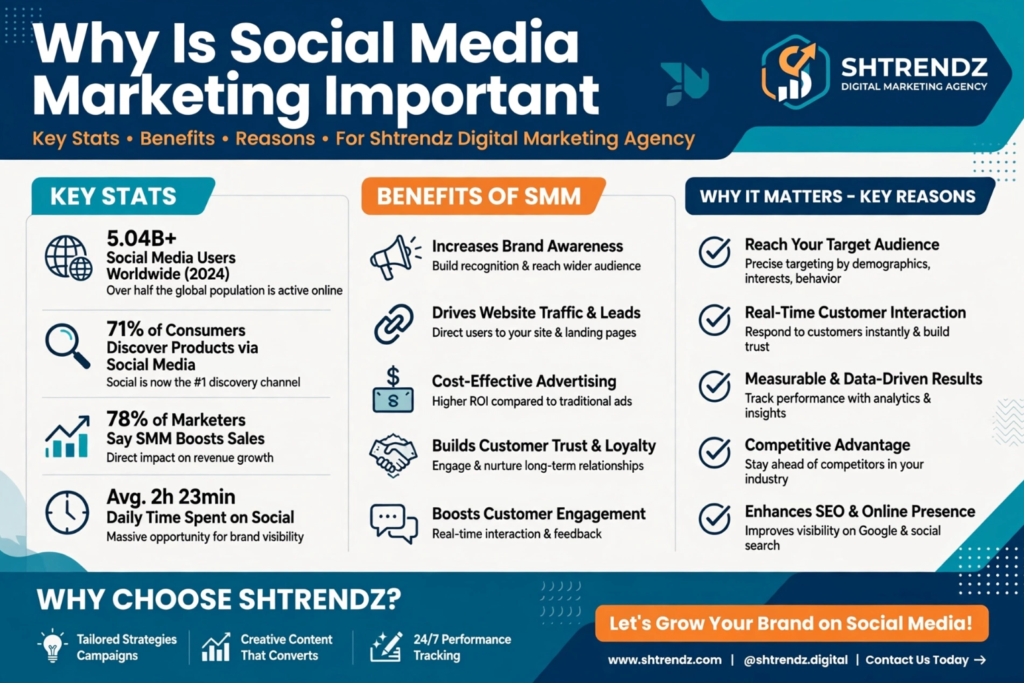
Social media marketing has become an important part of digital marketing because it allows businesses to communicate with audiences where they already spend time.
Here are some of its major benefits.
1. Increases Brand Awareness
Brand awareness refers to how familiar people are with your business, products, or services.
Regularly publishing useful and recognizable content helps people discover your brand. When users share your posts or recommend your business, your content may reach additional audiences.
For example, a small bakery can publish pictures of cakes, short videos of the baking process, customer reviews, and festival offers. These posts help people recognize the bakery and understand what makes it different.
2. Helps Reach Target Customers
Social media platforms provide different ways to reach audiences based on factors such as interests, demographics, location, and online behavior.
This is especially useful for small businesses that want to connect with customers in a particular city or region.
For example, a beauty salon in Delhi can create location-focused content and use relevant local hashtags to improve discoverability among nearby customers.
Paid advertising can offer additional targeting options, depending on the platform and campaign settings.
3. Builds Customer Relationships
Social media creates opportunities for two-way communication between businesses and customers.
People can comment on posts, ask questions, share feedback, and send direct messages. Responding promptly and professionally helps businesses build trust and understand customer needs.
A business that listens to its audience can improve its products, services, and customer experience.
4. Drives Website Traffic
Social media content can direct interested users to your website, blog, landing page, or online store.
For example, a digital marketing agency can share a short post explaining SEO mistakes and invite readers to visit its website for a detailed guide.
This approach can attract relevant visitors who are genuinely interested in the services or information being offered.
5. Supports Lead Generation and Sales
Social media can help businesses generate inquiries, collect leads, and convert interested users into customers.
Businesses can use product demonstrations, testimonials, special offers, lead forms, and clear calls to action to encourage potential customers to take the next step.
However, sales should not be the only focus. Providing helpful content and building credibility often make promotional messages more effective.
6. Provides Useful Customer Insights
Comments, messages, engagement statistics, and customer feedback can reveal what your audience likes and dislikes.
These insights help businesses identify popular products, understand common questions, and improve future campaigns.
Social media analytics also help marketers determine which content formats and topics produce the best results.
How to Choose the Right Social Media Platforms
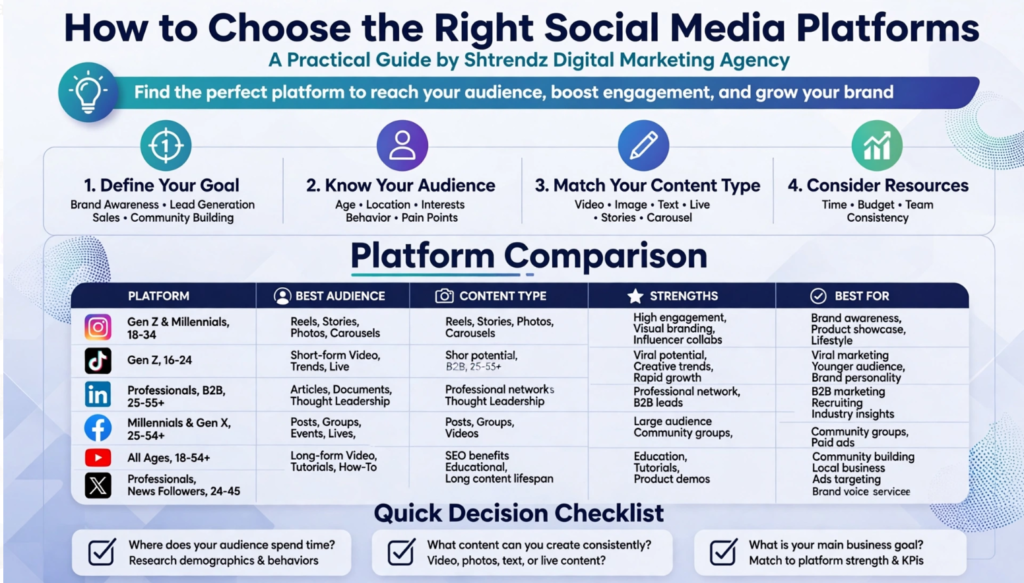
Beginners often make the mistake of creating accounts on every available platform. Managing too many accounts can reduce content quality and make consistency difficult.
Instead, begin with one or two platforms that match your audience and business objectives.
Instagram is useful for visual storytelling, product promotion, Reels, Stories, and creator collaborations.
It is particularly relevant to fashion brands, beauty businesses, restaurants, lifestyle creators, and visual service providers.
For example, a clothing store can publish styling tips, product demonstrations, customer photographs shared with permission, and behind-the-scenes videos.
Facebook supports business pages, community groups, events, video content, and advertising.
It can be useful for local businesses, service providers, community organizations, and brands that want to communicate with established customer groups.
A local shop might use Facebook to announce new stock, promote seasonal discounts, and answer customer questions.
LinkedIn is a professional networking platform that is useful for B2B marketing, recruitment, industry insights, and personal branding.
Digital marketers can use LinkedIn to share case studies, discuss marketing trends, showcase projects, and connect with potential employers.
For beginners seeking digital marketing internships, LinkedIn can also help demonstrate practical knowledge and professional interests.
YouTube
YouTube is suitable for educational videos, product demonstrations, tutorials, reviews, interviews, and longer-form content.
Businesses can publish videos that answer customer questions and demonstrate their expertise.
For example, a digital marketing website can create tutorials about keyword research, website optimization, and social media content planning.
Pinterest can help users discover visual ideas, products, designs, and inspiration.
It may be useful for fashion, home decor, recipes, weddings, crafts, and other visually oriented niches.
Businesses should consider whether their audience uses the platform before investing significant time in it.
Beginner’s tip: Choose your platforms based on audience behavior, not popularity alone. It is better to manage two platforms consistently than to maintain six inactive accounts.
Step-by-Step Social Media Marketing Strategy for Beginners
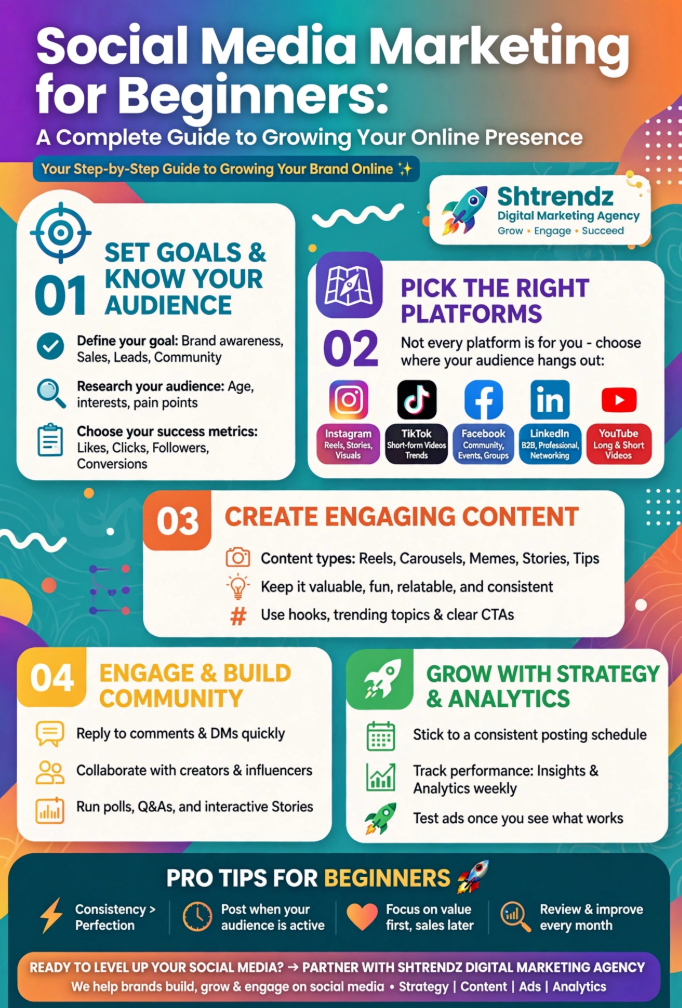
A Social Media Marketing for Beginners strategy should include clear goals, audience research, engaging content, and regular performance tracking.
A successful campaign begins with a plan. Follow these steps to create a practical social media marketing strategy.
Step 1: Define Your Marketing Goals
Before publishing content, decide what you want social media to achieve.
Common objectives include:
- Increasing brand awareness
- Growing relevant followers
- Improving engagement
- Driving website traffic
- Generating leads
- Increasing product sales
- Building a professional reputation
Your goals should be specific and measurable.
For example, instead of saying, “I want to grow my Instagram account,” set a goal such as, “I want to increase qualified profile visits by 20% over the next two months.”
The target should be realistic for your starting point, budget, audience, and publishing frequency.
Clear objectives make it easier to evaluate performance and identify areas for improvement.
Step 2: Identify Your Target Audience
Your target audience consists of the people most likely to benefit from your products, services, or content.
Understanding your audience helps you create relevant messages rather than publishing content without a clear purpose.
Consider the following questions:
- What age group are you trying to reach?
- Where does your audience live?
- What problems do they want to solve?
- What topics interest them?
- Which social media platforms do they use?
- What influences their purchasing decisions?
For example, a business selling affordable women’s clothing in India might focus on customers interested in everyday fashion, festive outfits, styling ideas, and budget-friendly shopping.
You can learn about your audience through customer conversations, social media insights, competitor research, surveys, and website analytics.
Avoid making assumptions without checking the available evidence.
Step 3: Research Your Competitors
Competitor research helps you understand what other businesses in your industry are doing.
Identify three to five relevant competitors and examine their public social media accounts.
Look at their:
- Content formats
- Posting frequency
- Most engaging posts
- Captions and calls to action
- Audience questions
- Brand presentation
- Promotional methods
The purpose is not to copy their content. Instead, identify what their audience responds to and where your business could provide something different.
For example, if competitors mainly publish product photographs, you might experiment with styling tutorials, comparison videos, or frequently asked questions.
Originality and audience relevance are more valuable than copying every trend.
Step 4: Optimize Your Social Media Profiles
Your profile is often the first place people visit after discovering your content.
A complete and professional profile makes it easier for potential customers to understand your business.
Follow these guidelines:
Profile picture: Use a recognizable logo or suitable professional photograph.
Username: Choose a simple username that is easy to remember.
Bio: Explain what you offer and whom you help.
Contact details: Add appropriate business contact information.
Website link: Direct visitors to your website, store, portfolio, or relevant landing page.
Highlights and pinned posts: Use available features to showcase services, products, frequently asked questions, or important information.
For example, a digital marketing business might use a bio such as:
“Helping small businesses grow online through SEO, social media, and digital marketing strategies.”
Your profile should communicate your value clearly rather than relying on complicated language.
Step 5: Create a Content Strategy
Content is the foundation of social media marketing.
A content strategy defines what you will publish, who it is for, which formats you will use, and what each post should achieve.
Beginners can organize their content into five categories.
Educational content: Share tips, tutorials, explanations, and answers to common questions.
Entertaining content: Create relatable videos, lighthearted posts, or relevant trends that suit your brand.
Promotional content: Introduce products, explain services, and announce offers.
Trust-building content: Share testimonials with permission, case studies, behind-the-scenes material, and examples of your work.
Interactive content: Use polls, questions, quizzes, and discussions to encourage participation.
For example, a digital marketing agency could publish an SEO tip on Monday, a Reel explaining a marketing concept on Wednesday, and a service-related post on Friday.
This variety keeps your account useful without making every post feel like an advertisement.
Step 6: Develop a Content Calendar
A content calendar helps you organize posts in advance.
Without a calendar, beginners may publish several posts one week and disappear the next.
A simple calendar can include the following columns:
| Date | Content Topic | Format | Platform | Goal |
|---|---|---|---|---|
| Monday | Three SEO mistakes | Carousel | Education | |
| Tuesday | Introduction to the business | Image | Awareness | |
| Wednesday | Social media marketing tip | Reel | Reach | |
| Thursday | Customer question | Text or video | Engagement | |
| Friday | Service introduction | Carousel | Leads | |
| Saturday | Weekly learning summary | Post | Professional branding |
This is an example, not a mandatory posting schedule. Adjust the frequency according to your available time and audience response.
You can create a content calendar using Google Sheets, Excel, or a planning tool.
Planning content in advance makes it easier to maintain consistency and improve quality.
Step 7: Create Engaging Social Media Content
Good content gives people a reason to stop scrolling, pay attention, and take action.
Use these practical techniques.
Write strong opening lines. Begin with a problem, question, surprising insight, or clear benefit.
For example: “Your Instagram posts are getting views but no inquiries. Here are three possible reasons.”
Use clear visuals. Select readable fonts, appropriate colors, and high-quality images or videos.
Keep your message focused. Avoid putting too many unrelated ideas into one post.
Provide value. Teach something useful, answer a question, or explain how your product solves a problem.
Add a call to action. Tell the audience what to do next, such as saving the post, commenting, visiting your website, or contacting your business.
Make content accessible. Use readable text, captions for videos where possible, and suitable contrast between text and backgrounds.
Tools such as Canva can help beginners create graphics, carousels, and simple promotional designs without advanced graphic design skills.
However, attractive design alone will not produce results if the content is irrelevant to your audience.
Step 8: Use Hashtags and Keywords Strategically
Hashtags and keywords can help users understand and discover your content.
Use relevant words naturally in captions, video titles, profile descriptions, and on-screen text where appropriate.
For example, a digital marketing post might discuss social media marketing, content planning, SEO, or small business growth.
Hashtags should describe the actual content rather than simply repeat popular terms.
Avoid adding unrelated hashtags or assuming that using a large number of hashtags automatically increases reach.
Platform search systems change over time, so review platform-specific recommendations and your own analytics to determine what works.
Step 9: Engage With Your Audience
Social media marketing involves communication, not just publishing.
Set aside time to respond to comments, answer direct messages, acknowledge feedback, and participate in relevant conversations.
You can encourage meaningful interaction by asking specific questions.
For example, a fashion business could ask, “Which style would you choose for a festive occasion: a simple kurta set or a heavily embroidered outfit?”
Respond to genuine questions with useful information instead of sending the same promotional message to everyone.
Avoid buying followers, using fake engagement, or posting repetitive comments on unrelated accounts. These practices can damage credibility and produce misleading performance data.
The goal is to build a relevant audience that is interested in your business.
Step 10: Understand Paid Social Media Advertising
Organic social media marketing involves publishing content and engaging with audiences without paying for distribution.
Paid social media marketing involves spending money to show advertisements to selected audiences.
Paid campaigns may help businesses increase awareness, drive website visits, generate leads, or promote products.
However, advertising should not be your first solution to every problem.
Before spending money, ensure that your profile is complete, your offer is clear, and your website or contact process works properly.
Start with a specific campaign objective and a controlled budget you can afford to lose while testing.
For example, a local salon might run an advertisement promoting a particular service to relevant people in its service area.
Monitor meaningful results such as qualified inquiries, cost per lead, purchases, and return on advertising spend.
High reach or numerous clicks do not automatically mean that a campaign is profitable.
Important Social Media Marketing Metrics to Track
Analytics help you determine whether your strategy is producing results.
You do not need to track every available metric. Focus on the measurements that relate to your goals.
Reach
Reach measures the number of unique accounts that have seen your content, according to the platform’s reporting method.
It helps you understand how widely your content is being distributed.
Impressions
Impressions generally represent the number of times content was displayed. The same person may generate multiple impressions.
Engagement
Engagement can include likes, comments, shares, saves, and other interactions supported by a platform.
Look beyond the total number of interactions. Consider which posts generate meaningful responses from your target audience.
Click-Through Rate
Click-through rate, or CTR, measures the percentage of relevant impressions or exposures that result in clicks, depending on the platform’s definition.
A common formula is:
CTR = (Clicks ÷ Impressions) × 100
For example, if an advertisement receives 50 clicks from 2,000 impressions, its CTR is 2.5%.
Conversion Rate
Conversion rate measures the percentage of relevant visitors or users who complete a desired action, such as making a purchase or submitting a lead form.
The exact calculation depends on how the campaign defines the eligible audience.
Cost Per Lead
Cost per lead is calculated by dividing advertising spend by the number of leads generated.
For example, if you spend ₹2,000 and generate 20 leads, the cost per lead is ₹100.
However, a low cost per lead is not automatically good. You should also consider whether those leads are relevant and likely to become customers.
Review performance weekly or monthly and use the results to improve your content and campaigns.
Common Social Media Marketing Mistakes Beginners Should Avoid
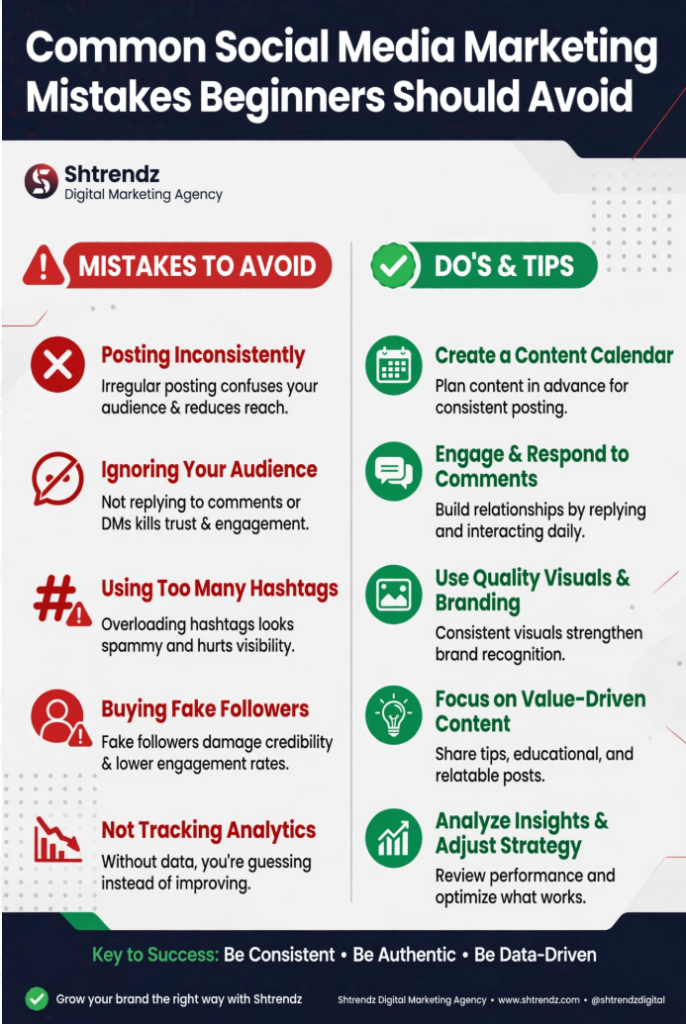
Many beginners struggle because they focus on activity instead of strategy.
Here are common mistakes to avoid.
1. Posting Without a Plan
Publishing random content makes it difficult to build a consistent brand identity.
Solution: Set clear goals and organize content around your audience’s needs.
2. Focusing Only on Followers
A large follower count does not guarantee website traffic, inquiries, or sales.
Solution: Track meaningful engagement, qualified leads, and conversions.
3. Ignoring Audience Comments
Unanswered questions can make a business appear unresponsive.
Solution: Check comments and messages regularly and provide helpful replies.
4. Copying Competitors
Repeatedly copying other accounts makes your brand less distinctive.
Solution: Learn from competitors while developing your own examples, opinions, and content formats.
5. Publishing Too Many Promotional Posts
If every post asks people to buy something, followers may lose interest.
Solution: Balance promotional content with education, entertainment, and trust-building material.
6. Expecting Instant Results
Building a relevant audience and establishing trust takes time.
Solution: Test your strategy consistently and evaluate results over a realistic period.
7. Ignoring Analytics
Without reviewing performance, you may continue investing time in content that does not support your goals.
Solution: Identify your strongest posts and investigate why they performed well.
8. Using Copyrighted Content Without Permission
Using photographs, videos, music, or designs without appropriate rights can create legal and platform-related problems.
Solution: Use original content, properly licensed assets, or material you have permission to publish.
Useful Social Media Marketing Tools for Beginners
The right tools can make Social Media Marketing for Beginners easier by simplifying content creation, scheduling, and analytics.
You do not need expensive software to begin learning social media marketing.
Several tools can help you create, schedule, and measure content.
Canva: Useful for designing social media posts, presentations, carousels, and promotional graphics.
Meta Business Suite: Helps eligible businesses manage Facebook and Instagram content, messages, and insights.
Google Analytics: Helps measure website traffic and understand how visitors arrive at and interact with your website.
Google Sheets: Useful for preparing content calendars, tracking performance, and recording campaign results.
LinkedIn Analytics: Helps users with eligible pages or accounts understand the performance of their content using available reporting features.
YouTube Studio: Provides creators with information about video performance, audience engagement, and channel growth.
Choose tools based on your actual needs. Learning how to interpret results is more important than subscribing to numerous platforms.
How Beginners Can Learn Social Media Marketing and Build a Portfolio
If you want to pursue a career in digital marketing, practical experience is essential.
Learning terminology is useful, but employers may also want evidence that you can apply your knowledge.
Start by creating a small project using a real business, a personal brand, or a clearly identified practice brand.
For example, you could develop a social media marketing project for a small clothing store.
Your project might include:
- A short business and competitor analysis.
- A target audience profile.
- A list of marketing objectives.
- A social media profile optimization plan.
- A 30-day content calendar.
- Ten sample posts created in Canva.
- Three short-form video concepts.
- A sample paid advertising campaign plan.
- A reporting dashboard with relevant metrics.
- Recommendations for improving future performance.
If you use a real business, obtain permission before accessing its accounts or publishing content on its behalf.
Clearly label simulated campaigns and sample results. Never present hypothetical performance figures as actual client results.
You can add your project to your portfolio website or LinkedIn profile and explain the problem, strategy, creative decisions, and expected measurements.
This approach helps you demonstrate your thinking and practical skills when applying for internships or entry-level positions.
Future Trends in Social Media Marketing
Social media marketing continues to change as platforms introduce new features and audiences develop new habits.
Several developments are worth monitoring.
Artificial Intelligence in Content Creation
AI tools can help marketers brainstorm topics, prepare initial captions, summarize research, and develop content ideas.
However, AI-generated material still requires human review for accuracy, originality, brand voice, and relevance.
Publishing generic AI content without editing can make a brand less distinctive.
Short-Form Video
Short-form video remains an important format across platforms that support Reels, Shorts, and similar content.
Businesses can use short videos to explain products, answer questions, demonstrate processes, and share practical tips.
Strong opening moments and clear storytelling can help capture attention.
Influencer and Creator Partnerships
Brands may collaborate with creators whose audiences match their target customers.
The right partnership depends on audience relevance, credibility, content quality, and business objectives—not follower count alone.
Businesses should also follow applicable advertising disclosure rules.
Social Search
People increasingly use social platforms to discover products, services, recommendations, and educational content.
Clear captions, descriptive titles, relevant keywords, and useful information can improve the chances of content being discovered through platform search.
Community Building
Businesses can strengthen customer relationships by encouraging conversations, responding to feedback, and creating content that addresses shared interests.
A relevant and active community can provide valuable feedback and support long-term customer loyalty.
These trends should inform your strategy, but you do not need to adopt every new feature immediately. Test changes that fit your audience and measure their results.
Frequently Asked Questions (FAQs)
1. What is social media marketing for beginners?
Social media marketing for beginners involves learning how to use social media platforms to promote a business, create useful content, connect with an audience, increase brand awareness, and support business goals.
It includes profile optimization, content planning, audience engagement, analytics, and, when appropriate, paid advertising.
2. How can I start social media marketing with no experience?
Start by learning the basics of one or two platforms. Create a practice account or work on a small portfolio project.
Learn to design posts, write captions, prepare content calendars, understand audience engagement, and measure performance.
Practical projects will help you apply your knowledge.
3. Which social media platform is best for beginners?
There is no single best platform for every beginner.
Instagram may suit visual brands, Facebook may support local communities and businesses, LinkedIn may be useful for professional networking, and YouTube may suit educational video content.
Choose based on your target audience and objectives.
4. Is social media marketing free?
You can begin with free business accounts and organic content. However, social media marketing still requires time, planning, and effort.
Paid advertising, premium software, professional content creation, and influencer partnerships may involve additional costs.
5. How often should beginners post on social media?
Posting frequency depends on your platform, audience, resources, and content quality.
Start with a manageable schedule, such as three useful posts per week, and adjust according to performance.
Consistency and relevance matter more than publishing large amounts of low-quality content.
6. How long does it take to see results from social media marketing?
Results vary according to your industry, audience, content, competition, budget, and objectives.
Some campaigns may generate immediate website visits or inquiries, while building an engaged audience and a recognizable brand can take much longer.
Measure progress regularly instead of expecting guaranteed results within a fixed period.
7. Can social media marketing help small businesses?
Yes. Social media can help small businesses introduce their products, communicate with customers, demonstrate expertise, and attract potential buyers.
The results depend on the quality of the offer, audience relevance, consistency, and the effectiveness of the marketing strategy.
8. What skills are needed for social media marketing?
Important skills include content creation, copywriting, basic graphic design, audience research, communication, strategic planning, analytics, and advertising fundamentals.
Familiarity with tools such as Canva and platform analytics can also be useful.
9. What is the difference between organic and paid social media marketing?
Organic marketing uses unpaid content and interactions to reach and engage audiences.
Paid social media marketing uses advertising budgets to distribute promotional content to selected audiences.
Businesses often combine both approaches, depending on their goals and resources.
10. How can I measure social media marketing success?
Define success according to your objective.
For awareness, examine reach and impressions. For engagement, review interactions and relevant engagement metrics. For website traffic, track clicks and analytics data. For sales, measure conversions, revenue, and advertising costs.
The most useful metrics are those connected to your business goals.
Learning Social Media Marketing for Beginners requires consistency, creativity, and a willingness to improve your strategy based on results.
Conclusion
Social media marketing for beginners becomes easier when you approach it as a structured process rather than a series of random posts.
Start by defining your goals, understanding your target audience, choosing suitable platforms, and optimizing your profiles. Develop a practical content strategy, publish useful material consistently, engage with your audience, and measure the results.
Avoid focusing exclusively on followers, trends, or likes. Instead, determine whether your efforts are helping you reach the right people, build trust, generate relevant inquiries, and achieve meaningful business outcomes.
If you are learning digital marketing, use these principles to build a practical portfolio and gain experience with real or clearly labelled practice projects.
Remember: Successful social media marketing is not about being present everywhere. It is about being useful, consistent, and relevant where your audience spends its time.
Start small, learn from your results, and improve your strategy step by step. With practice and patience, you can develop the skills needed to grow your online presence and support long-term business growth.